
Cheap suits in Bangkok are one of the great travel temptations. You are walking down Sukhumvit, someone waves you toward a shop, and within minutes you are quoted a suit, two shirts, and a tie for less than a nice dinner back home. Sometimes it is a genuine bargain. Very often it is a trap dressed up as one.
Bangkok has earned a reputation as a place to get clothes made for almost nothing, and that reputation quietly costs travellers who cannot yet tell a real tailored suit from a costume that fits for a week. This guide breaks down the 5 shortcuts behind most cheap suits in Bangkok, why they happen, and how to spot the difference before you hand over any money.
The short version
Cheap suits in Bangkok usually cut costs in three places you cannot see at the fitting: fused (glued) construction instead of a stitched canvas, low grade fabric sold under a premium sounding name, and rushed stitching with a single hurried fitting. The suit looks acceptable in the shop and for the first few wears, then the lapels bubble, the shape collapses, and the fit was never truly yours. The good news is that Bangkok also makes excellent suits at fair prices. The trick is knowing which shop you are standing in.
Why Bangkok has a reputation for cheap suits
Most of the damage comes from one corner of the market, not from Bangkok tailoring as a whole. Around the tourist strips you find shops built entirely around volume and speed. They rely on touts and tuk-tuk drivers to funnel walk-in tourists through the door, they promise a finished suit in 24 hours, and they compete on one number only: the headline price on the pavement sign.
None of that is compatible with a well made garment. A proper suit needs time, several fittings, real cloth, and skilled hands. A shop selling a full three piece suit for a couple of thousand baht cannot pay for those things and still profit, so it does not. The low price is not a bargain. It is a preview of the corners about to be cut. If you want the honest numbers, our Bangkok tailored suit price guide shows what quality actually costs.
What actually goes wrong with cheap suits in Bangkok
Here are the 5 shortcuts that define almost every cheap suit in Bangkok. Learn them and you can screen out the worst shops in a single conversation.
1. It is glued together, not stitched
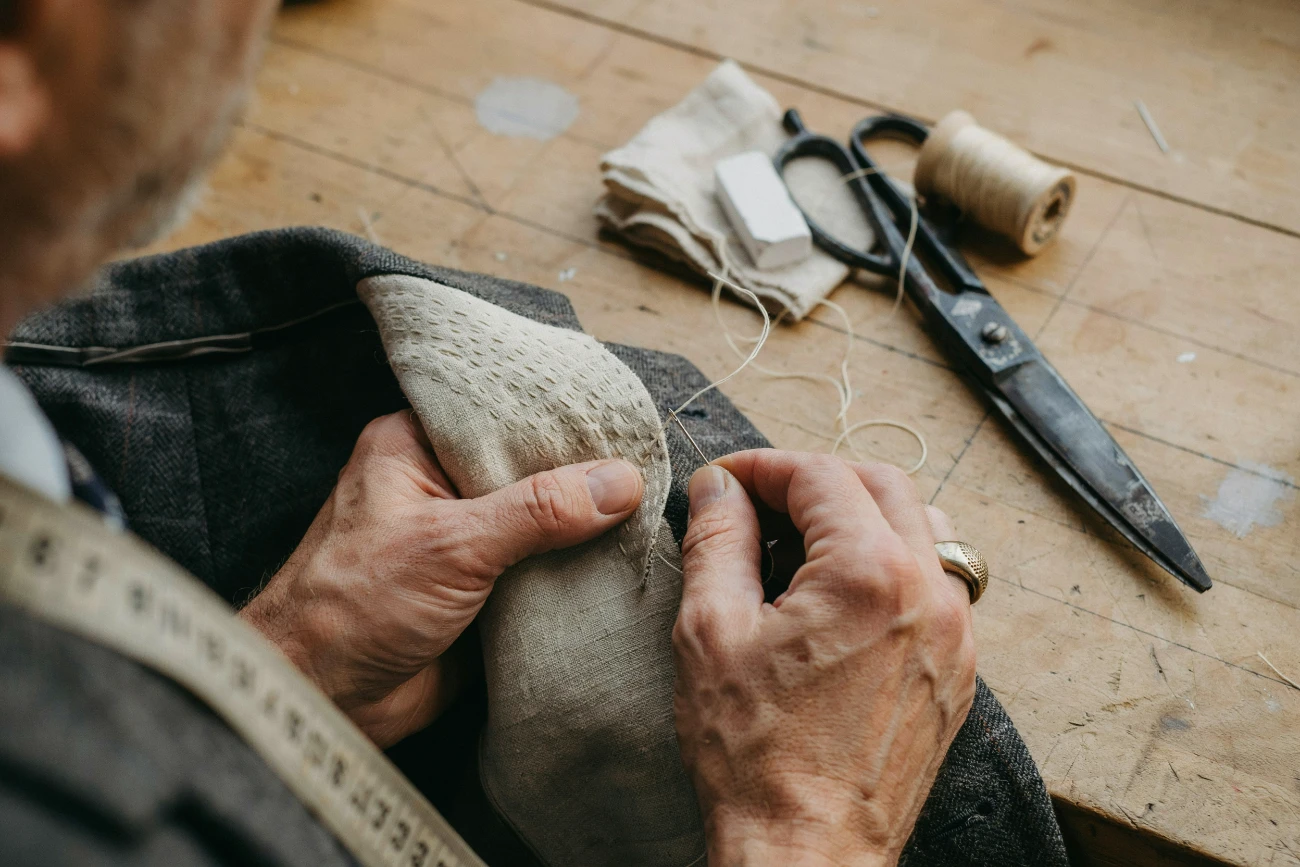
This is the single biggest one. A quality jacket has a layer of canvas inside the chest and lapels that is stitched in, giving the jacket structure and letting it mould to your body over time. Cheap suits skip this and use fusing, where the inner structure is glued to the outer fabric with heat and adhesive.
Fused jackets are fast and cheap to make, and they fail in a predictable way. After a few dry cleans or a few humid Bangkok afternoons, the glue separates and the chest and lapels develop bubbling that no tailor can fix. For the full breakdown, see our guide to bespoke versus made-to-measure versus off-the-rack. You can also read how jacket suit construction works in general terms.
2. Mystery fabric wearing a premium label
Cheap shops lean hard on words like wool, cashmere, and Italian, often with none of it in the cloth. What you frequently get is a heavy polyester blend that looks acceptable under shop lighting but does not breathe, holds heat, wrinkles badly, and takes on a cheap sheen in daylight. In Bangkok’s climate, an airless synthetic suit is close to unwearable.
A real tailor names the mill, the composition, and the weight, and lets you handle the bolt. If the answer to “what is this made of” is vague or rehearsed, treat it as a warning. Our fabrics page shows what genuine suiting cloth looks like.
3. One fitting, or none at all
The 24-hour suit is the clearest tell. A garment made that fast is either cut from a near-stock pattern with minimal adjustment or run up overnight with a single rushed fitting. Either way, the fit is approximate. It might look passable while you stand still, but it will pull, gape, and twist the moment you move.
Good tailoring is iterative. It usually takes at least one fitting on a partly finished garment so the tailor can correct the fit on your actual body, not on an average of everyone who walked in that week.
4. Finishing done fast and by machine
Look inside a cheap suit and the shortcuts appear: uneven machine stitching where handwork belongs, buttonholes that look stamped out rather than sewn, a lining bagged in loosely, and pattern matching no one bothered to line up. Individually small, together they are the gap between a garment that reads as expensive and one that quietly reads as cheap.
5. Stitched offshore in a hurry
Many bargain shops are storefronts, not workshops. Your measurements get sent to a high volume facility with a fast turnaround and no relationship to the person who measured you. If something is wrong, there is no skilled tailor on site to own the problem and fix it properly. You are left with whatever comes back.

The false economy: what cheap suits in Bangkok really cost
The tempting maths is that a cheap suit is basically free next to home prices, so even if it lasts a while, it paid for itself. In practice it rarely works out.
A fused suit in synthetic cloth with an approximate fit does not last. The structure goes, the fabric ages badly, and it never fit well enough to earn regular wear. Most people wear it a handful of times, quietly retire it, and buy again. You did not save money on a suit. You paid for a souvenir that looked like one. A single well made suit that fits and survives years of wear is almost always the cheaper garment over its life.
How to spot quality before you pay
You do not need to be an expert to filter out the worst shops. You need a few questions and the confidence to walk away if the answers are weak.
- Ask how the jacket is constructed. You want to hear half canvas or full canvas. If they say fused, or do not understand the question, you have your answer.
- Ask what the fabric is and where it is from. A real tailor names the mill, composition, and weight without hesitating, and lets you handle the cloth.
- Ask how many fittings are included. One quick fitting or none is a red flag. Anyone promising a suit in 24 hours is telling you which corners they cut.
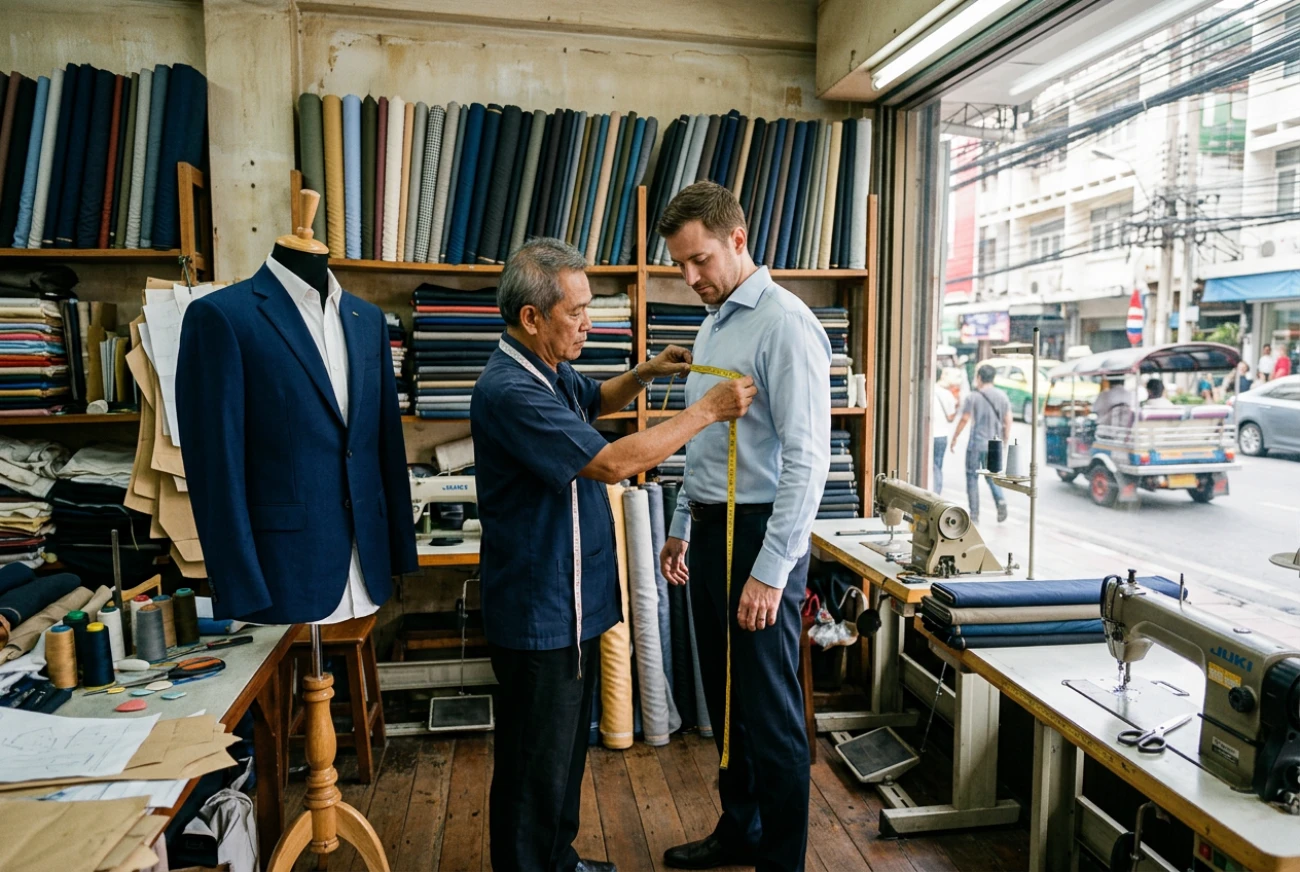
- Ask where the suit is actually made. An on-site workshop with tailors you can meet beats a storefront that ships your measurements to a factory.
- Look at their finished work and reviews. Inspect the inside of a made garment, check the buttonholes and lining, and read what past customers say about how the suit held up months later.
- Be honest about the price. If the number seems too good to be true for a real tailored suit, it is. Quality cloth and skilled labour have a floor.
For a fuller framework, our guide on choosing the right tailor goes deeper.
What a fair price actually looks like in Bangkok
Bangkok’s real advantage was never that it is the cheapest. It is that it offers genuine value: quality tailoring well below what you pay in London, New York, or Sydney, without the corner cutting of the tout shops. A properly canvassed suit in good cloth, cut and fitted by skilled tailors, sits at a price that reflects real materials and labour and still looks like a bargain next to home. That is the sweet spot to aim for, and it is a completely different product from the pavement-sign special.
Getting it right
A cheap Bangkok suit is not really cheap. It is a garment engineered to look right for the length of your holiday and then quietly fall apart. The alternative is not to spend home-country money. It is to spend a fair Bangkok price at a shop that stitches its canvas, names its cloth, and fits you properly across more than one visit.
At Galaxy Tailor, that is the entire model: canvassed construction, cloth we can tell you everything about, and fittings in our own Sukhumvit workshop. If you would rather get it right the first time, book a consultation and see the difference before you commit.
Frequently asked questions
Are cheap suits in Bangkok always bad?
Not always, but the risk is high. The reputation problem comes from the high volume, fast turnaround shops that fuse, use synthetic cloth, and skip fittings. Bangkok also has excellent tailors offering real quality at a fair price, so cheap is the warning sign, not Bangkok itself.
Why is a 24-hour suit a problem?
Speed forces shortcuts. A suit made overnight is cut with minimal adjustment and little or no proper fitting, so the fit is approximate and the construction rushed. Good tailoring needs time and at least one fitting to correct the fit on your body.
What is the difference between fused and canvassed?
A canvassed jacket has an inner layer stitched in, giving structure that lasts and moulds to you. A fused jacket has that structure glued in, which is cheaper but tends to bubble and separate after cleaning and humidity.
How much should I pay for a good suit in Bangkok?
Enough to cover real cloth and skilled labour, which puts a proper canvassed suit well above the pavement-sign price but still well below home prices. If a full suit is offered for a couple of thousand baht, that price is the warning.